
WorkSafeBC Claims: Active Rehab vs. Time Off Work
Recovering from a workplace injury? Learn how Active Rehab can help Vancouver workers rebuild strength, mobility, confidence, and return-to-work capacity after a WorkSafeBC claim.

WorkSafeBC Claims: Active Rehab vs. Time Off Work
12–18 minutes

Nadia Joybari, R.Kin
✓ Registered Kinesiologist (BCAK)
✓ 10+ Years Experience
✓ ICBC Approved Provider
🎯 Key Takeaway
Time off work may be necessary after some workplace injuries, but rest alone does not always rebuild function.
Active Rehab helps injured workers gradually restore:
- Strength
- Mobility
- Movement confidence
- Physical tolerance
- Work capacity
- Functional endurance
- Long-term resilience
For many people recovering from workplace injuries, the goal is not simply to “wait until the pain goes away.” The goal is to build the body’s capacity back up so work, daily movement, and physical activity become more manageable again — while also reducing the chance of repeated flare-ups or future injury.
After a workplace injury, many people wonder whether they should take time off work, rest completely, or start Active Rehab.
This can be confusing, especially when pain is still present and work duties feel physically demanding. Some people worry that returning to movement too early may make the injury worse. Others feel pressure to return to work before they feel ready.
The truth is usually somewhere in the middle.
Rest can be important in the early stage of an injury, especially when symptoms are intense or when work duties are unsafe. However, staying inactive for too long can sometimes slow recovery, reduce strength, increase stiffness, and make it harder to return to work confidently.
Active Rehab focuses on helping injured workers rebuild movement, strength, endurance, and confidence in a structured way. For many workplace injuries, this can become an important part of safely progressing from injury to modified duties, and eventually to fuller work participation.
As a registered Kinesiologist providing Active Rehab in Vancouver, I often work with people recovering from workplace-related injuries who feel unsure about how much they should move, what exercises are safe, and how to prepare their body for the physical demands of work again. For people who need structured support after a job-related injury, Work Injury Active Rehab can help bridge the gap between pain, reduced function, and a safer return to daily work demands.
What is the difference between Active Rehab and taking time off work?
Taking time off work usually means reducing or stopping work duties temporarily, so the injured area has a chance to settle. This may be appropriate when symptoms are acute, work tasks are unsafe, or the person cannot perform essential duties without aggravating the injury.
Active Rehab is different.
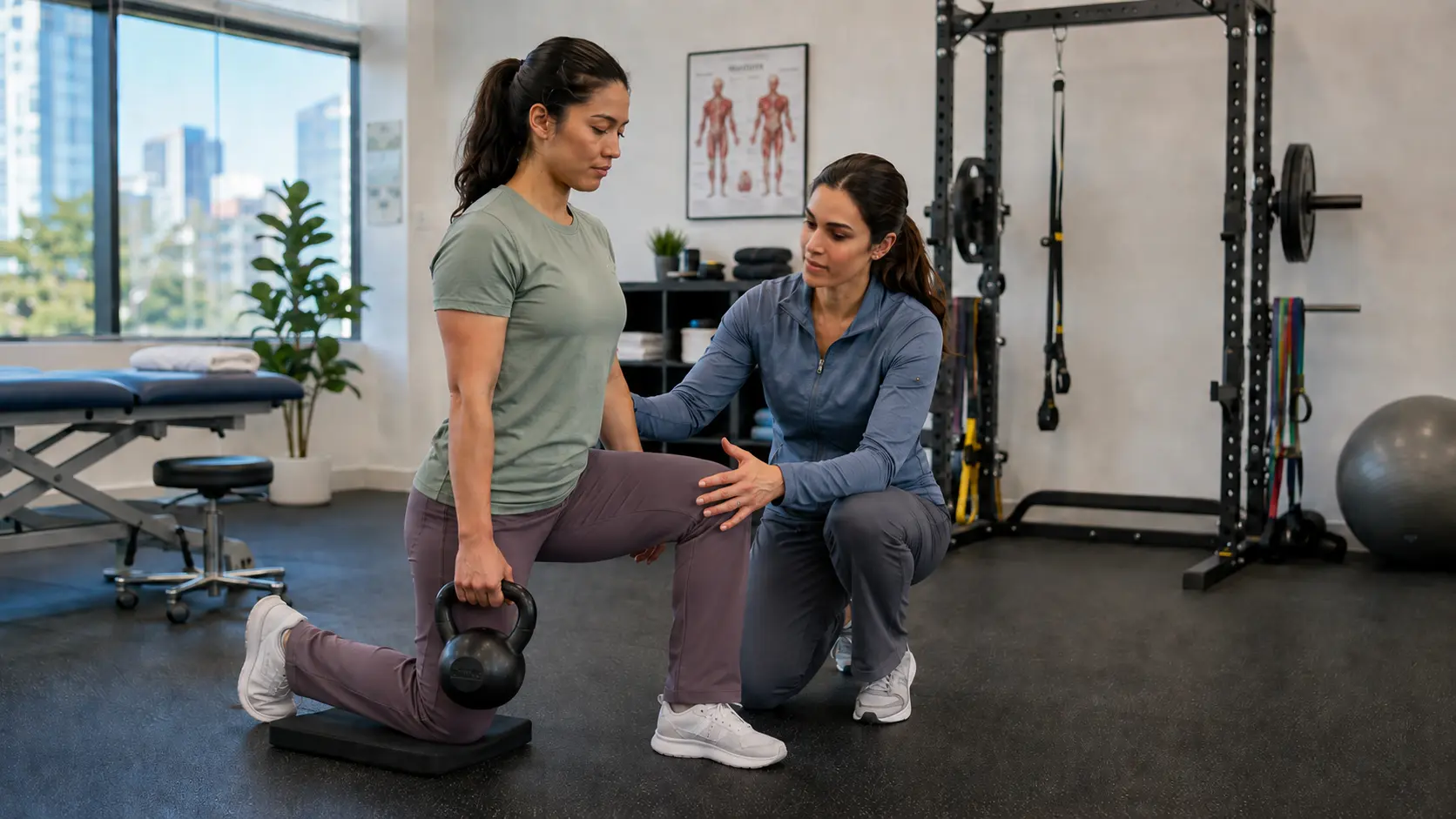
Active Rehab includes assessment of your injury and pain, guided movement to support active healing, movement progression, strength rebuilding, mobility work, functional training, and return-to-work preparation. A Kinesiology Injury Prevention & Active Rehab approach looks beyond the painful area and considers how the body moves as a whole. Instead of only focusing on the painful area, a Kinesiologist evaluates how the body moves as a whole and how different movement systems work together. This helps identify the underlying contributors to pain and dysfunction, so the rehab plan can address the root cause of the problem within the entire body as a connected system.
While time off work may reduce short-term physical stress, Active Rehab helps rebuild the physical capacity needed to return to work safely. In many cases, both may be used together. A worker may need a short period away from regular duties while also beginning appropriate rehabilitation. As symptoms improve, Active Rehab can help bridge the gap between injury and full work demands.
Does WorkSafeBC want injured workers to return to work?
In general, WorkSafeBC supports safe and timely return to work when it is appropriate. This does not mean someone should ignore pain or return to unsafe duties before they are ready. It means recovery is often supported by staying connected to work, using modified duties when needed, and gradually increasing capacity over time.
A return-to-work plan may include:
- Reduced hours
- Modified duties
- Temporary task restrictions
- Gradual increase in workload
- Functional rehabilitation
- Communication between the worker, employer, health care providers, and WorkSafeBC
The focus should be safe return to work, not rushed return to work.
For many injured workers, the challenge is not motivation. The challenge is knowing what their body can safely handle and how to progress without causing repeated flare-ups. This is where Active Rehab can be helpful. When pain keeps returning or symptoms flare with movement, Pain Relief Active Rehab may help by addressing strength, mobility, movement patterns, pacing, and physical tolerance instead of relying only on rest or short-term symptom relief.
Is rest ever helpful after a workplace injury?
Yes. Rest can be helpful, especially in the early stage of injury.
After a workplace injury, the body may need time for pain, inflammation, muscle guarding, and sensitivity to settle. In some cases, reducing certain movements or avoiding specific work duties is appropriate.
However, rest should usually have a purpose.
Rest is most useful when it helps symptoms settle enough to begin gradual movement again. It becomes less helpful when it turns into long-term avoidance, fear of movement, or complete inactivity. For workers dealing with repeated flare-ups from typing, gripping, lifting, or repetitive daily tasks, understanding the repetitive strain injury work-pain cycle can also help explain why symptoms often return when the body has not rebuilt enough tolerance.
Prolonged rest may lead to:
- Loss of strength
- Reduced cardiovascular fitness
- Joint stiffness
- Muscle tightness
- Lower work tolerance
- Increased fear of movement
- Reduced confidence
- More difficulty returning to job demands
The goal is not to push through pain aggressively. The goal is to find the right starting point and progress gradually.In general, WorkSafeBC supports safe and timely return to work when it is appropriate. This does not mean someone should ignore pain or return to unsafe duties before they are ready. It means recovery is often supported by staying connected to work, using modified duties when needed, and gradually increasing capacity over time.
Why can too much time off work slow recovery?
When someone is off work for a long time, the body may become less prepared for the demands of the job.
This is especially important for physically demanding jobs that involve:
- Standing for long periods
- Walking
- Lifting
- Carrying
- Bending
- Squatting
- Reaching
- Pushing or pulling
- Repetitive tasks
- Working in awkward positions
Even if pain improves with rest, the body may still not be ready for the same workload as before. This is because rest may calm symptoms, but it does not automatically restore strength, endurance, balance, coordination, or tissue tolerance. This is especially common when someone is dealing with lower back pain after heavy work, where the body may feel better at rest but still struggle when lifting, bending, carrying, or standing for longer periods.
For example, a worker may feel better after several weeks away from lifting. But once they return to repeated lifting, symptoms may flare again because the body was not prepared for that demand. Active Rehab helps reduce this gap by rebuilding the physical qualities needed for work.
How does Active Rehab help after a workplace injury?
Active Rehab can help by creating a structured plan to restore movement and function after a workplace injury.
Depending on the injury and the worker’s goals, Active Rehab may include:
- Movement assessment
- Strength training
- Mobility exercises
- Core stability training
- Postural endurance work
- Balance and coordination exercises
- Functional movement retraining
- Work-specific conditioning
- Gradual lifting progressions
- Squatting, bending, reaching, or carrying practice
- Education around pacing and symptom response
- Return-to-work preparation
The purpose is not just to exercise randomly. The purpose is to match rehabilitation to the person’s injury, current tolerance, job demands, and recovery stage. A Kinesiologist can identify what limitations are contributing to current symptoms, what the individual can currently safely tolerate, and how to progress movements and loads safely over time.
What if I am not ready to return to my full job duties?
Not being ready for full duties does not always mean you cannot do anything.
In many cases, workers return through modified duties or gradual hours. This may allow the person to stay connected to the workplace while avoiding tasks that exceed their current physical tolerance. When the next step feels unclear, a return to work assessment can help identify whether the body is ready for specific work demands or whether more capacity-building is needed first.
Modified duties may include:
- Shorter shifts
- Reduced lifting
- Less repetitive bending
- More sitting or standing breaks
- Avoiding overhead work
- Avoiding heavy carrying
- Changing task frequency
- Temporary restrictions on specific movements
- Gradual return to regular duties
Active Rehab can support this process by preparing the body for the next step.
For example, if a worker needs to return to lifting, rehabilitation may include progressive strengthening, hip hinge practice, core control, grip endurance, and gradual load exposure. If the job requires prolonged standing, the program may include lower-body endurance, foot and ankle conditioning, hip strengthening, and standing tolerance progression.
The goal is to make return to work more realistic, more measurable, and more sustainable.
Does WorkSafeBC want injured workers to return to work?
In general, WorkSafeBC supports safe and timely return to work when it is appropriate. This does not mean someone should ignore pain or return to unsafe duties before they are ready. It means recovery is often supported by staying connected to work, using modified duties when needed, and gradually increasing capacity over time.
How can a Kinesiologist help with return-to-work planning?
A registered Kinesiologist focuses on movement correction, exercise prescription, physical conditioning, and functional rehabilitation.
For workplace-injury-related Active Rehab, a Kinesiologist may help by assessing:
- Pain triggers
- Movement limitations
- Strength deficits
- Mobility restrictions
- Balance or coordination challenges
- Postural endurance
- Lifting mechanics
- Work-specific physical demands
- Current activity tolerance
- Fear or uncertainty around movement
From there, the program can be built around the worker’s actual needs.
For example, a warehouse worker may need progressive lifting and carrying. A nurse may need transfer strength, standing tolerance, and body mechanics. A hairstylist may need shoulder endurance, prolonged standing capacity, and postural strength. A construction worker may need squatting, bending, pushing, pulling, climbing, and full-body strength.
Active Rehab should connect directly to the real movements a person needs for work and daily life.
When should I start Active Rehab after a workplace injury?
The right time to start Active Rehab depends on your injury, symptoms, medical guidance, and, when applicable, your WorkSafeBC claim status.
In many cases, Active Rehab can begin earlier than people think, as long as the movements are appropriate for your stage of recovery. Depending on your assessment findings, early Active Rehab may begin with gentle mobility, breathing strategies, light muscle activation, walking progression, basic movement control, or education around safe activity. From there, your rehabilitation can gradually progress as your body becomes stronger, more tolerant, and better prepared for your work duties.
You may benefit from Active Rehab if:
- Pain is limiting your work duties
- You feel weaker after the injury
- You are worried about moving the wrong way
- You have been resting but not improving
- You keep having flare-ups when you try to do more
- You are returning to modified duties
- You need to rebuild strength before full duties
- You feel unsure how to progress safely
- Your job has physical demands you are not ready for yet
The earlier someone receives appropriate guidance, the easier it may be to avoid long-term deconditioning, fear of movement, and repeated setbacks.
What types of workplace injuries can Active Rehab help with?
Active Rehab may help with many musculoskeletal workplace injuries, especially when pain, weakness, stiffness, reduced mobility, or reduced work tolerance are part of the problem.
Common examples include:
- Low back pain
- Neck pain
- Shoulder injuries
- Hip or knee injuries
- Ankle and foot injuries
- Repetitive strain injuries
- Lifting injuries
- Sprains and strains
- Postural overload
- Overuse injuries
- Return-to-work conditioning after time away
Active Rehab can also be helpful when symptoms have improved but the worker still does not feel strong, stable, or confident enough to return to regular duties.
This is an important point: pain reduction and full recovery are not always the same thing.
Someone may have less pain but still lack the strength, endurance, and movement capacity needed for their job. Active Rehab helps build that missing capacity.
How can Vancouver workers rebuild strength after injury?
In Vancouver, many workers have physically demanding jobs across health care, trades, hospitality, film, retail, construction, education, and service-based industries. Even jobs that do not look “heavy” can still involve repetitive stress, prolonged standing, awkward positions, or sustained postures.
A gradual Active Rehab plan may include:
- Short walking progressions
- Gentle mobility work
- Movement assessment
- Corrective movements
- Foundational strength
- Core and hip stability
- Upper-body endurance
- Balance and coordination
- Work-simulation activities
- Lifting and carrying progressions
- Education around pacing
- Return-to-activity planning
For many people, the biggest shift is learning that recovery does not require choosing between complete rest and pushing too hard.
There is a middle zone. That middle zone is where the body is challenged enough to adapt but not overwhelmed so much that symptoms keep flaring. A good Active Rehab plan helps identify that zone and build from there.
Why choose Active Rehab instead of just waiting?
Waiting may reduce symptoms in some cases, but it does not always rebuild the physical ability needed for work.
Active Rehab gives recovery more structure. Instead of guessing, you can identify what movements need to improve, which areas need strengthening, what activities still trigger symptoms, which work demands need preparation, how to progress without overdoing it, how to rebuild confidence after injury, and how to reduce the likelihood of re-injury. This is especially important when someone is preventing re-injury after returning to work, because feeling “mostly better” does not always mean the body is fully prepared for regular duties.
Active Rehab helps create a clearer pathway from injury to function.
When recovery feels uncertain, having a structured plan can make it easier to understand what your body needs next. For many workplace injuries, the goal is not simply to return as quickly as possible, but to rebuild the strength, movement quality, confidence, and physical capacity needed for work to feel manageable again.
A well-designed Active Rehab plan can help you progress gradually, prepare for your job demands, and reduce the likelihood of re-injury as you return to daily life and work.
At Up Athletics & Rehab in Vancouver, Active Rehab is individualized to your symptoms, movement limitations, job demands, and recovery goals. The focus is helping you recover with a plan, rebuild function, and return to work with greater confidence.
Located in Vancouver | Active Rehab with a Registered Kinesiologist | Workplace injury rehabilitation support
Ready to Start Kinesiology Active Rehab?
Begin with a clinical rehabilitation plan guided by assessment, whole-body movement analysis, and your functional goals.
A Registered Kinesiologist in Vancouver can provide individualized Active Rehab to address symptoms, restore movement and function, and support a safe return to daily activities.
Located in Vancouver | Private insurance receipts available when kinesiology is covered
Frequently Asked Questions
For important health and safety information, please see our medical disclaimer, privacy policy, and terms of use.