

Pelvic Organ Prolapse: What Exercise Is Safe and How Should You Progress?
Pelvic organ prolapse does not always mean stopping exercise. Learn how breathing, pressure management, strength, and clinical reasoning can guide safer progression back to lifting, running, and everyday activity.

Pelvic Organ Prolapse: What Exercise Is Safe and How Should You Progress?
14–21 minutes

Nadia Joybari, R.Kin
✓ Registered Kinesiologist (BCAK)
✓ 10+ Years Experience
✓ ICBC Approved Provider
Pelvic organ prolapse (POP) affects millions of women, yet many receive little guidance beyond “avoid heavy lifting” or “do your Kegel exercises.” As a result, everyday activities such as exercising, carrying groceries, lifting children, or returning to the gym can become sources of uncertainty and anxiety.
One of the most common questions people ask after receiving a diagnosis is:
“Can I still exercise safely?”
For most people, the answer is yes.
If you have been told to stop exercising altogether—or you worry that every episode of pelvic heaviness or pressure means you have caused further damage—you are not alone. These are common concerns after a pelvic organ prolapse diagnosis.
Pelvic organ prolapse does not automatically mean you need to avoid exercise or lifting for the rest of your life. In many cases, remaining physically active can form an important part of rehabilitation. However, safe rehabilitation involves more than simply choosing exercises that feel tolerable in the moment. It requires clinical reasoning to determine an appropriate starting point, identify factors that may be contributing to symptoms, and decide how movement demands should be modified or progressed.
Some people begin avoiding meaningful activities because they are afraid of worsening the prolapse. Others continue exercising without understanding why certain combinations of load, impact, fatigue, breathing strategy, or exercise volume repeatedly increase their symptoms. Neither complete avoidance nor unrestricted progression is usually the goal.
Rather than classifying exercises as permanently “safe” or “unsafe,” clinically guided rehabilitation considers how your body responds to different physical demands and uses that information to safely progress rehabilitation toward meaningful functional capacity. This may include gradually improving your ability to manage everyday lifting, work demands, recreation, resistance exercise, or higher-impact activities when appropriate.
In this guide, you will learn what pelvic organ prolapse is, why symptoms vary between individuals, which exercises are often better tolerated, how lifting and running may be approached, and how clinical assessment can help guide a safer return to the activities that matter to you.
🎯 Key Takeaway
Most people with pelvic organ prolapse can continue exercising safely. Rehabilitation uses clinical assessment findings to determine an appropriate starting point and identify factors contributing to symptoms. The goal is to improve pelvic floor coordination, breathing and pressure management, movement quality, functional strength, and readiness for progressively more demanding activities.
What is pelvic organ prolapse?
Pelvic organ prolapse occurs when one or more pelvic organs descend from their usual position because the tissues supporting them are no longer managing everyday physical forces as effectively as before.
Depending on the structures involved, prolapse may affect the:
- bladder, known as a cystocele
- rectum, known as a rectocele
- uterus, known as uterine prolapse
- small bowel, known as an enterocele
- vaginal vault following hysterectomy
The pelvic floor contributes to organ support, but it does not function in isolation. Its role within the broader core and pelvic floor connection also involves the diaphragm, abdominal wall, hips, and surrounding trunk muscles.
For this reason, pelvic organ prolapse should not be reduced to simply having a “weak pelvic floor.” Two people with the same type or stage of prolapse may respond very differently to walking, standing, lifting, coughing, or exercise. Symptoms are also influenced by coordination, movement strategy, physical conditioning, fatigue, bowel function, recovery, and the demands of the activity.
Movement-based rehabilitation therefore considers how the pelvic floor works with the rest of the body rather than focusing only on isolated strengthening.
What causes pelvic organ prolapse?
Pelvic organ prolapse usually develops through a combination of factors rather than one single cause. These may include:
- pregnancy and vaginal childbirth
- menopause and ageing
- connective tissue changes
- chronic constipation or repeated straining
- persistent coughing
- previous pelvic surgery
- higher body weight
- repeated heavy work or recreational demands
For example, repeated constipation, chronic coughing, heavy lifting, and insufficient recovery may create a different overall physical load than the same prolapse diagnosis in someone without those additional demands.
Rehabilitation does not aim to eliminate every source of pressure or blame one particular activity. Instead, it identifies which factors may be modifiable and helps the person manage breathing, movement, recovery, lifting, and exercise more effectively.
What symptoms can pelvic organ prolapse cause?
Symptoms vary considerably between individuals. Some people have more advanced anatomical prolapse with few symptoms, while others experience significant discomfort despite smaller structural changes.
Common symptoms may include:
- pelvic heaviness or pressure
- vaginal bulging or a sensation of something descending
- urinary leakage
- difficulty emptying the bladder
- constipation or difficulty emptying the bowel
- pelvic aching
- lower-back discomfort
- symptoms during prolonged standing
- discomfort during lifting or exercise
- discomfort during sexual activity
Symptom severity does not always match prolapse stage. Symptoms may also change depending on total daily activity, bowel function, coughing, fatigue, exercise volume, prolonged standing, lifting demands, and recovery.
This means that one episode of heaviness or pressure does not provide the complete clinical picture. Rehabilitation decisions should consider symptom behaviour alongside functional limitations, movement demands, recovery patterns, and the person’s goals.
Can you exercise with pelvic organ prolapse?
Yes. Most people with pelvic organ prolapse can continue exercising safely.
The goal is usually not to eliminate movement, lifting, or physical activity. It is to determine an appropriate starting point, identify which combinations of load, impact, fatigue, breathing strategy, or exercise volume may currently be contributing to symptoms, and guide progression toward meaningful activities.
Advice surrounding prolapse can sometimes become overly restrictive. Some people are told to avoid lifting permanently, while others are advised simply to “listen to their body.” Neither recommendation fully reflects the complexity of rehabilitation.
An exercise feeling tolerable in the moment does not necessarily mean it is the appropriate rehabilitation level. Clinical reasoning considers:
- movement quality and coordination
- breathing and pressure-management strategies
- strength and physical conditioning
- symptom behaviour during and after activity
- fatigue and recovery
- exercise history
- work, household, recreational, and caregiving demands
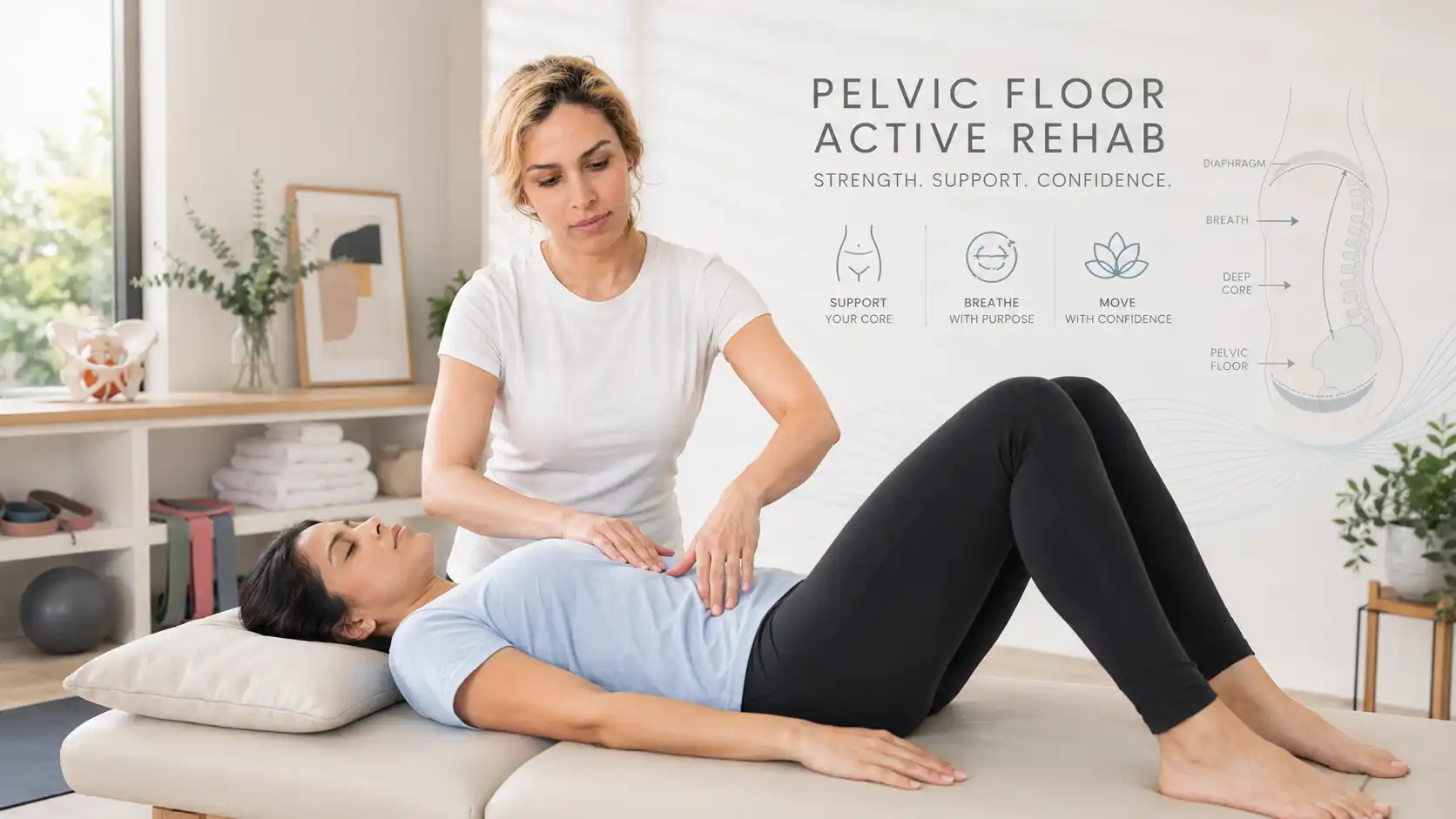
A structured Pelvic Floor Active Rehab plan with a Kinesiologist can help identify an appropriate starting point, restore coordinated pelvic floor and whole-body function, and progressively integrate these skills into functional exercise.
For example, two people may appear able to complete the same squat exercise. One may maintain consistent breathing and movement quality, coordinate the pelvic floor effectively, and recover without difficulty. The other may gradually hold their breath, brace excessively, change their technique as fatigue develops, or experience increasing pelvic heaviness later in the day.
The second person may first benefit from targeted therapeutic rehabilitation exercises that improve pelvic floor contraction, relaxation, breathing, pressure management, and coordination with the trunk and hips. Because pelvic floor function involves more than isolated Kegel exercises, these foundational skills can then be integrated into supported squats and progressively more demanding functional exercises.
Although both individuals can complete the squat, one may be ready to progress while the other may first need to restore coordinated pelvic floor and whole-body function. Safe rehabilitation therefore considers not only what can be tolerated today, but whether the person has the preparation needed to progress the exercise appropriately.
Clinical Perspective
One of the most common misconceptions about pelvic organ prolapse is that every increase in symptoms indicates structural damage.
In reality, symptoms provide valuable information, but they do not necessarily mean that permanent harm has occurred.
Just as muscle soreness after exercise does not automatically indicate injury, temporary increases in pelvic heaviness or pressure may sometimes reflect that an activity exceeded your current capacity rather than causing new tissue damage.
Clinical reasoning uses symptom behaviour, movement quality, recovery, and the overall presentation to determine whether an activity should be continued, modified, temporarily reduced, or progressed.
Which exercises are generally well tolerated with pelvic organ prolapse?
There is no universal list of exercises that is safe or unsafe for everyone with pelvic organ prolapse.
Exercise selection depends on the relationship between the demands of the activity and the person’s current strength, coordination, symptom behaviour, movement strategy, and ability to recover.
Rehabilitation often begins with exercises that can be modified easily, such as:
- walking or stationary cycling
- sit-to-stand exercises
- supported squats and step-ups
- hip and lower-limb strengthening
- controlled trunk exercises
- upper-body resistance exercises
- functional lifting using an appropriate load and range
A supported squat may still be inappropriate if excessive depth, repetitions, breath-holding, or total workload produces symptoms that do not recover well.
Higher-demand activities may require more preparation, including:
- running and jumping
- heavier or repeated lifting
- high-intensity exercise
- rapid changes of direction
- high-volume abdominal exercise
- activities involving repeated straining or poorly managed downward pressure
These activities are not automatically prohibited. However, they may need to be introduced gradually after the necessary strength, movement skills, pressure-management strategies, and conditioning have been developed.
Pelvic Floor Active Rehab with a Kinesiologist identifies an appropriate entry point, modifies relevant exercise variables, and progresses the activity when movement and recovery indicate that the next level is appropriate.
Can you lift weights or run with pelvic organ prolapse?
Many people with pelvic organ prolapse can continue or gradually return to resistance training and running.
The more useful question is not:
“Can I ever lift or run again?”
It is:
“What preparation does my body need to perform and recover from this activity appropriately?”
Preparation may involve improving:
- hip, leg, and trunk strength
- breathing and pressure management
- pelvic floor coordination and strength
- lifting or running mechanics
- general conditioning
- tolerance to fatigue
- recovery between activities
Someone may complete a lifting session without symptoms but develop increasing pelvic pressure later after prolonged standing, household work, or carrying groceries. In that case, the problem may not be the lift alone. The accumulated demand of the entire day may have exceeded the person’s current capacity.
Similarly, symptoms during running do not necessarily mean running must be abandoned permanently. A structured return may begin with lower-impact conditioning, progressive strengthening, shorter intervals, reduced speed, less hill work, and gradual exposure to impact.
When returning to running, a more detailed running gait and movement assessment may help identify whether impact management, lower-limb strength, stride mechanics, or conditioning should be addressed during progression.
Temporary reductions in load, impact, or exercise volume can provide an opportunity to improve contributing factors. Progression can then occur in stages rather than repeatedly provoking prolonged flare-ups.
Do breathing, pressure management, and Kegel exercises matter?
Yes, but they are only part of a broader rehabilitation approach.
The pelvic floor works with the diaphragm, abdominal wall, trunk, and hips to manage pressure during breathing, coughing, lifting, and exercise. Effective breathing and pelvic floor coordination helps these systems respond together as physical demands change.
Depending on the assessment findings, rehabilitation may include:
- breathing and pressure-management strategies
- pelvic floor contraction and relaxation
- trunk and hip strengthening
- movement and lifting mechanics
- functional coordination
- general conditioning and recovery
Kegel exercises may be appropriate when reduced pelvic floor strength or endurance is contributing to symptoms. However, they are not a universal solution.
Some people can contract the pelvic floor but have difficulty relaxing it. Others may hold their breath, brace excessively, or create greater downward pressure while attempting a contraction. A person may also perform Kegels correctly while lying down but struggle to coordinate the pelvic floor during standing, lifting, coughing, or exercise.
Movement-based Pelvic Floor Active Rehab therefore considers whether the pelvic floor can contract, relax, and coordinate within real-life movement—not only whether someone can complete isolated contractions.
Clinical Perspective
Being able to complete a functional exercise does not always mean the body is ready to train it directly.
Some people may first need targeted therapeutic exercises to improve pelvic floor contraction, relaxation, breathing, pressure management, and coordination with the trunk and hips. These skills can then be integrated into squatting, lifting, running, and other functional activities.
Does an internal pelvic floor assessment always lead to a better rehabilitation plan?
Not necessarily.
A consent-based internal pelvic floor assessment can provide detailed information about muscle tone, tenderness, contraction, relaxation, coordination, and localized findings that cannot be examined directly through external movement assessment. It may be particularly useful when symptoms are painful, unusual, persistent, not improving as expected, or associated with significant bladder, bowel, or sexual-function concerns.
However, more detailed information about individual pelvic floor muscles does not automatically lead to more appropriate exercise selection or better functional outcomes.
A Kinesiologist with expertise in Pelvic Floor Active Rehab can use external clinical findings—including symptom behaviour, breathing and pressure-management strategies, movement quality, trunk and hip function, strength, fatigue, recovery, and response to load—to determine an appropriate starting point and develop an effective functional rehabilitation plan.
For many people, findings gathered through an external Kinesiology assessment provide enough information to begin rehabilitation and progressively integrate the pelvic floor into standing, lifting, work, exercise, running, and everyday movement. When clinically indicated, a separate consent-based internal pelvic floor assessment performed by an appropriately trained provider may offer complementary information, but it is not automatically required for effective movement-based rehabilitation.
Once enough information has been gathered to identify the main limitations and guide care safely, rehabilitation quality depends less on obtaining increasingly detailed isolated findings and more on expertise in functional exercise prescription, sequencing, and progression toward real-life demands.
How do you know if you are exercising at the right level with pelvic organ prolapse?
The appropriate exercise level is not determined by avoiding every symptom or by pushing through increasing discomfort.
A temporary symptom increase does not automatically mean further damage has occurred. However, symptoms that repeatedly worsen, remain elevated for longer than expected, interfere with daily activities, or prevent recovery before the next session may indicate that the current exercise dose should be modified.
Assessment considers:
- symptom behaviour during and after activity
- whether symptoms return to their usual baseline
- movement quality
- breathing and pressure management
- strength and coordination
- fatigue and conditioning
- functional goals
- recovery before the next exercise session
Mild heaviness that settles quickly and does not affect the remainder of the day may be interpreted differently from symptoms that continue to increase, persist into the following day, or interfere with work, walking, or household activities.
The goal is to provide enough challenge to promote adaptation while allowing appropriate recovery. This often means progressing neither too quickly nor too cautiously.
Clinical Perspective
Not every increase in symptoms requires stopping exercise.
Clinical reasoning considers symptom intensity, timing, duration, consistency, recovery, movement quality, and functional demands. Together, these findings help determine whether an activity should be maintained, modified, reduced, or progressed.
When should you seek professional assessment for pelvic organ prolapse?
A professional assessment may be appropriate when symptoms are:
- persistent or progressively worsening
- interfering with bladder or bowel function
- limiting exercise, work, or daily activities
- associated with significant pain
- making it difficult to determine how to exercise safely
Seek medical assessment promptly for difficulty emptying the bladder or bowel, increasing or pronounced vaginal bulging, unexplained bleeding, or new and significant pelvic pain.
A clinical Kinesiology Active Rehab assessment evaluates symptom behaviour, movement mechanics, neuromuscular coordination, strength, breathing and pressure-management strategies, fatigue, recovery, and functional capacity to determine an appropriate rehabilitation starting point and guide progression toward work, exercise, and daily activity demands.
A clinical assessment can help identify how movement mechanics, breathing, pelvic floor coordination, strength, conditioning, recovery, and daily physical demands may be contributing to symptoms.
For people seeking movement-based rehabilitation, a kinesiologist with Pelvic Floor Active Rehab expertise can help translate these findings into a structured exercise progression aimed at meaningful functional outcomes.
Exercise Decision Guide
Should You Continue Exercising with Pelvic Organ Prolapse?
Use this guide to help organize your next step. Symptoms should be considered alongside their severity, duration, recovery pattern, movement quality, and your overall clinical presentation.
Are your symptoms mild or manageable, and do they return to your usual baseline after exercise?
↓
Yes
Continue at the current level Continue exercising while monitoring your response. Progress gradually rather than increasing several exercise variables at the same time.
No
Modify the exercise demand Consider adjusting one variable, such as load, impact, repetitions, duration, range of motion, exercise complexity, or recovery time.
↓
After modifying the activity, do your symptoms become more manageable and recover appropriately?
↓
Yes
Continue from the modified level Allow time for adaptation, then progress gradually while continuing to monitor symptom behaviour and recovery.
No
Consider a professional assessment Assessment may help identify contributing factors and determine whether the activity should be further modified, temporarily reduced, or progressively rebuilt.
Seek medical assessment promptly if you experience:
- Difficulty emptying your bladder or bowel
- Increasing or pronounced vaginal bulging
- New or significant pelvic pain
- Bleeding that is not explained by menstruation
- Symptoms that are persistent, progressively worsening, or interfering with daily activities
This guide is educational and cannot determine the cause or severity of an individual’s symptoms. Exercise decisions should be based on the full clinical presentation rather than symptoms alone.
What is the main goal of pelvic floor active rehabilitation?
The goal is not simply to reduce symptoms or identify one perfect exercise.
Effective rehabilitation helps you understand how your body responds to physical demands and uses that information to guide movement, exercise, and activity progression.
Over time, the objective is to improve confidence, strength, coordination, recovery, and tolerance for the activities that matter to you—including lifting, work, household responsibilities, recreation, resistance exercise, and running.
Pelvic organ prolapse does not automatically mean giving up meaningful movement. With appropriate assessment, exercise selection, and progression, many people can remain active and gradually return to more demanding activities at a level their body is prepared to manage.
Ready to Start Kinesiology Active Rehab?
Begin with a clinical rehabilitation plan guided by assessment, whole-body movement analysis, and your functional goals.
A Registered Kinesiologist in Vancouver can provide individualized Active Rehab to address symptoms, restore movement and function, and support a safe return to daily activities.
Located in Vancouver | Private insurance receipts available when kinesiology is covered
Frequently Asked Questions
For important health and safety information, please see our medical disclaimer, privacy policy, and terms of use.