

Running Gait Analysis: Understanding Your Unique Pattern

Running Gait Analysis: Understanding Your Unique Pattern
8–12 minutes

Nadia Joybari, R.Kin
✓ Registered Kinesiologist (BCAK)
✓ 10+ Years Experience
✓ ICBC Approved Provider
🎯 Key Takeaway
Running gait analysis is not about finding a perfect stride.
It is about understanding how your body moves, where load is going, and what may be contributing to pain or inefficiency.
The goal is to help you run in a way that feels more sustainable, efficient, and comfortable over time.
Most runners have asked this at some point. Why does my stride feel smooth one day and awkward the next? Why do I keep getting tight calves, sore knees, or one hip that always seems to work harder? Why does someone else make running look effortless while my body feels like it is negotiating every step?
That is where running gait analysis becomes useful. Not because there is one perfect way to run. And not because every runner needs to look the same. But because your body has patterns. Some of them help you. Some of them quietly ask one area to do more than it should. Over time, that matters.
A small shift in load, timing, or control may not feel important during one run. But after hundreds or thousands of steps, even small patterns can start to add up. That is often when runners begin noticing recurring tightness, nagging pain, or the sense that something about their stride just does not feel right.
Running gait analysis is really about understanding that pattern more clearly.
What is running gait analysis?
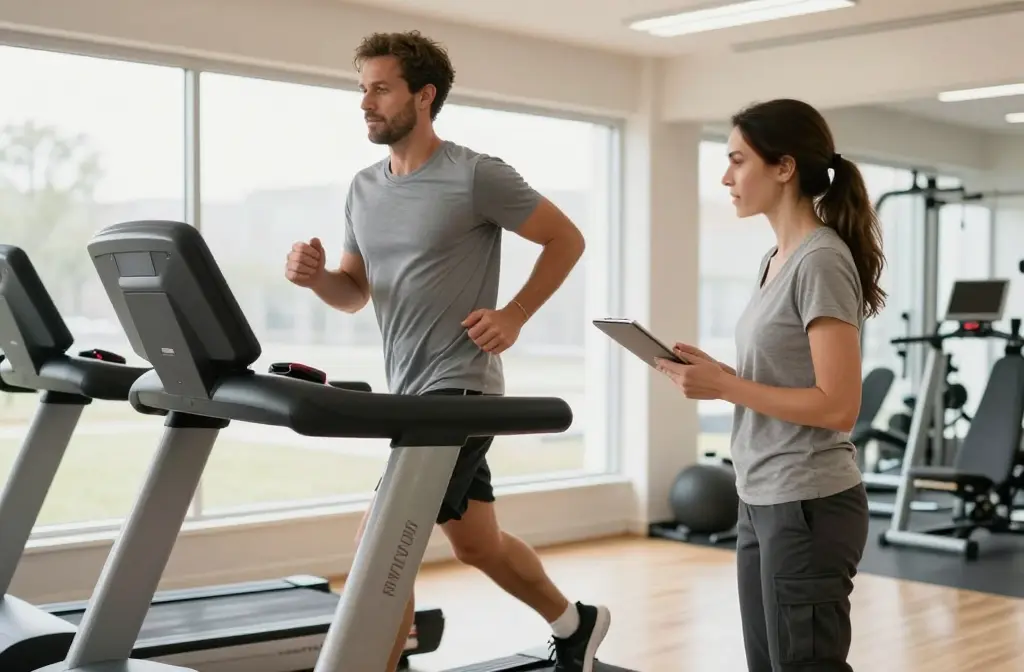
Running gait analysis is a closer look at how you run. It looks at the movement pattern behind your stride. Not just where your foot lands, but how the whole body works together while you run. That includes posture, cadence, arm swing, pelvic control, trunk position, step length, loading pattern, and how one side compares with the other. In simple terms, it helps answer a useful question: What is your body actually doing while you run?
That matters because running happens quickly. Most runners cannot feel every detail of their own stride in real time. They may know that something feels off, but they cannot always tell whether the issue starts at the foot, the hip, the trunk, or the way fatigue is changing their mechanics.
Gait analysis helps slow that down. It gives the pattern a shape. It turns “my knee always gets sore” into something more specific, like overstriding, reduced hip control, poor load sharing, or a cadence that is making each step heavier than it needs to be. That does not mean every difference is a problem. Some differences are just differences. But when a pattern keeps feeding the same irritation, gait analysis can help show where the body may be working harder than it should.
Why do all runners have different running patterns?
Because no two runners bring the same body, history, or habits into a run. Your stride is shaped by many things. Your strength. Your mobility. Your injury history. Your training volume. Your coordination. Your footwear. Your speed. Your fatigue. Even your confidence and how safe your body feels under load can influence the way you run.
That is why two runners can be equally strong, equally experienced, and still move very differently.
One runner may look smooth and springy. Another may look heavier through the ground but still feel fine. One may rely more on the ankle and calf. Another may use the hip more. One may lose control as soon as fatigue shows up. Another may stay steady for longer. That does not automatically make one style right and the other wrong. It just means every runner has a unique pattern.
The real question is not whether your gait looks exactly like someone else’s. The real question is whether your pattern is serving you well. Is it efficient enough for your goals? Is it tolerable for your training volume? Is one area quietly doing too much work? Is the body adapting well to the demands you are placing on it?
That is one reason Functional Movement Screening: Identifying Risk Factors can connect so well with running gait analysis. Sometimes the way someone runs reflects a broader movement pattern that also shows up in balance, stepping, hinging, or single-leg control. Your running pattern is personal. That is exactly why it is worth understanding.
Can running gait analysis help prevent injuries?
It can help, especially when the goal is to catch patterns before they become bigger problems.
Gait analysis does not promise that a runner will never get injured. Running injuries are rarely caused by one thing alone. Training load, recovery, tissue capacity, sleep, stress, terrain, footwear, and past history all matter too. But gait analysis can still be very useful. Why?
Because injuries often build gradually. A runner may keep training with a stride that overloads the same calf, the same knee, or the same hip over and over. That pattern might feel manageable at first. Then it becomes tightness after longer runs. Then soreness. Then the kind of recurring irritation that keeps coming back every few weeks. That is often how running injuries begin. Quietly.
This is where Overuse Injury Prevention: Listen to Your Body fits in well. Overuse injuries are usually not about one dramatic mistake. They are more often about repeated load going through a pattern that the body is no longer tolerating well. Gait analysis can help identify those repeated patterns earlier.
Maybe the issue is overstriding. Maybe it is poor trunk control. Maybe one hip drops more than expected. Maybe the cadence is low enough that each step creates more braking and loading than necessary. Maybe the runner is rotating more through one side, or losing position as soon as fatigue shows up. None of these observations matter in isolation. They matter because of the bigger picture.
If the same movement pattern keeps feeding the same pain, then seeing that pattern clearly can help guide what to work on next.
A kinesiologist can assess and identify faulty movement patterns and other movement-related factors that may be affecting your running. Through active rehabilitation and targeted exercise, they can address those issues to improve movement quality, reduce unnecessary strain, and help your body run more comfortably over time.That is what makes gait analysis useful for injury prevention. Not because it finds one magic flaw. Because it helps make the load story easier to understand.
What does a running gait analysis actually look at?
d it is often not the most important part.
A more useful analysis usually looks at things like:
- posture and trunk position
- arm swing and rhythm
- cadence
- step length
- pelvic control
- hip stability
- knee tracking
- ankle stiffness or collapse
- side-to-side differences
- how mechanics change with fatigue or speed
That last point matters a lot.
Many runners look fine for the first few minutes. The more useful information sometimes appears later, when they tire, tense up, or lose the ability to share load well. That is often when compensations show up more clearly. This is why running gait analysis is not only about what looks unusual. It is about what seems costly.
Where is the body losing efficiency? Where is it borrowing movement from another area? Where is one tissue likely taking more load than it can comfortably handle right now?
That question often connects well to Core Stability for Injury Prevention and Strength Training for Injury Prevention. If the trunk is not offering enough control, or the hips are not managing load well, the running pattern may reflect that. In those cases, the answer is not just “run differently.” It may be “build the body’s capacity so a better pattern is easier to hold.”
Sometimes gait analysis also leads into return-to-run planning, cadence adjustments, strength work, mobility work, or small cueing changes that make the stride feel smoother and less effortful. The point is not to overcorrect every detail. It is to understand which details actually matter.
When should a runner consider gait analysis?
Usually when something keeps showing up. That might be pain. Tightness. Recurring soreness. A feeling that one side is always doing more work. A stride that feels awkward after an injury. A return to running that does not feel as smooth as expected. Or simply a runner who wants a clearer understanding of how their body handles load before increasing mileage or speed.
A lot of runners wait until something becomes obvious. That is understandable. But gait analysis can be just as useful before the problem becomes bigger. It can help when:
- you keep getting the same running-related ache
- one side always feels tighter or more fatigued
- you are returning to running after injury
- your running form changes as you tire
- you are increasing mileage or intensity
- your body feels inefficient even when training is going well
It can also help newer runners who have never really understood how their body runs, and experienced runners who have plateaued or started noticing changes in efficiency, comfort, or recovery. Sometimes the biggest value is clarity. Not a huge correction. Not a complete overhaul. Just a clearer understanding of what your body is doing and why. That can make the next steps much more useful.
For some runners, that next step may involve kinesiology active rehab to address the movement pattern itself through active rehabilitation, strength work, and targeted exercise. For others, especially when symptoms are already limiting training, Pain Relief Active Rehab may fit better at first. Either way, the goal stays the same:
- Not to chase a perfect running style.
- To help your unique pattern become more sustainable.
The best running gait isn’t the one that looks textbook perfect. It’s the one your body can tolerate, repeat, and recover from well enough to keep you running exactly as you want.
Ready to Start Kinesiology Active Rehab?
Begin with a clinical rehabilitation plan guided by assessment, whole-body movement analysis, and your functional goals.
A Registered Kinesiologist in Vancouver can provide individualized Active Rehab to address symptoms, restore movement and function, and support a safe return to daily activities.
Located in Vancouver | Private insurance receipts available when kinesiology is covered
Frequently Asked Questions
For important health and safety information, please see our medical disclaimer, privacy policy, and terms of use.